Compliance & Safety ·
7 min read
OSHA and Commercial Cleaning: What It Requires and How We Stay Compliant
OSHA sets specific standards for cleaning companies around chemical handling, PPE, and employee training. Here's what those rules actually require and what compliance looks like in practice.
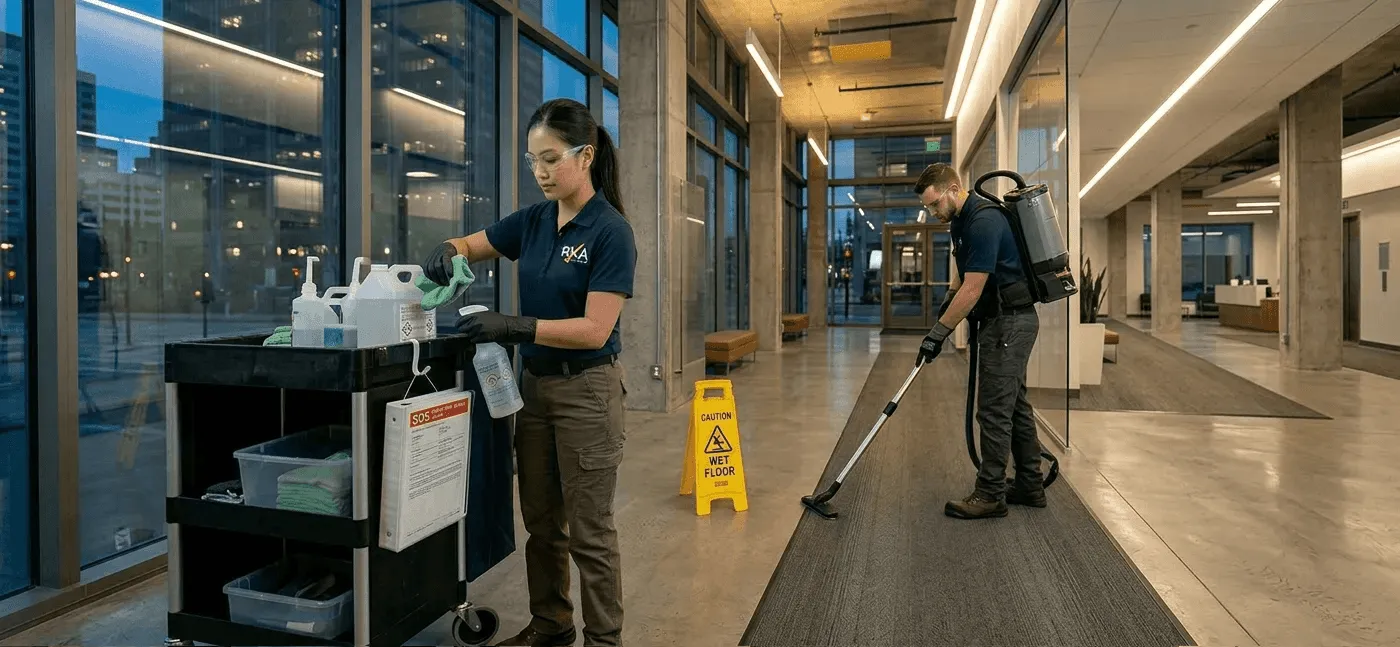
OSHA stands for the Occupational Safety and Health Administration, a federal agency under the U.S. Department of Labor. It sets and enforces workplace safety standards. For cleaning companies, compliance isn’t optional and it isn’t vague. There are specific regulations covering how crews handle chemicals, what protective equipment they wear, and what training they need before they step into your building.
Most commercial cleaning clients never ask about any of this. They should.
What OSHA actually requires for cleaning operations
OSHA doesn’t have a single “cleaning company standard.” Several regulations apply depending on what’s being done and where.
Hazard Communication Standard (HazCom), 29 CFR 1910.1200
This is the big one. Any cleaning company using chemical products, and all of them do, must maintain a Safety Data Sheet (SDS) for every hazardous chemical they use. SDS documents cover what’s in the product, how to handle it safely, what to do in case of exposure, and proper disposal. The standard also requires a written hazard communication program and a list of the hazardous chemicals on hand.
Shipped containers carry the full Globally Harmonized System (GHS) label, a standardized format using pictograms and signal words to communicate hazard level. A secondary spray bottle needs at least the product identifier plus words or symbols giving the hazard. The one exception is a bottle a worker fills, uses and empties on the same shift. Any other unlabeled container, or no SDS on file? That’s a violation.
One rule sits above all of that paperwork. Never mix bleach with ammonia, and never mix bleach with an acid cleaner. Bleach and ammonia give off chloramine gas. Bleach and a toilet bowl or descaling acid give off chlorine gas. Both put people in the emergency room, and both happen in restrooms, which is where a cleaning crew spends most of its shift. CDC says it flatly: never mix bleach with ammonia or any other cleaner. Crews have to know which products cannot share a surface or a bucket.
Personal Protective Equipment, 29 CFR 1910.132
OSHA requires employers to assess the workplace hazards their crew will encounter and provide appropriate PPE. For cleaning, that typically means chemical-resistant gloves, eye protection for concentrated products, and respiratory protection in some environments.
Handing someone gloves isn’t enough. The regulation requires documented hazard assessments and training on what the PPE covers and when to use it.
Bloodborne Pathogens Standard, 29 CFR 1910.1030
This applies anywhere employees may encounter blood or other potentially infectious materials. For cleaning companies servicing restrooms, gyms, or medical offices, that means:
- A written Exposure Control Plan, reviewed and updated at least annually
- Hepatitis B vaccination offered at no cost within 10 working days of assignment
- Training at initial assignment and at least annually after that, with records kept
- Post-exposure evaluation and follow-up after a needlestick or a splash
- Training on handling and disposing of contaminated waste
- Proper sharps disposal, and contaminated broken glass picked up with a brush and dust pan, tongs or forceps, never by hand
Walking-Working Surfaces, 29 CFR 1910.22
Wet floor signs aren’t a courtesy. OSHA requires walking surfaces be kept free of hazards including spills, and that a hazardous condition be corrected or guarded before anyone walks it again. The standard protects employees, not the public. A wet floor doesn’t check ID, so the signs go up either way.
What the gear actually looks like
Most people picture a cleaning crew with a mop and a spray bottle. The full picture depends on what’s being cleaned.
For routine office cleaning, the baseline is chemical-resistant gloves and eye protection when applying concentrated disinfectants or degreasers. Non-slip footwear is standard. So are aprons when working with anything that splashes.
The gear gets more specific when the job demands it.
Respirators and masks are required under OSHA’s Respiratory Protection Standard (29 CFR 1910.134) when airborne contaminants exceed safe exposure limits, or when ventilation can’t adequately control them. That’s not just a rule on paper. Floor stripping chemicals, heavy-duty degreasers, solvent-based products, and high-concentration disinfectants can all off-gas at levels that make a dust mask useless.
A dust mask and a respirator are not the same thing. An N95 filters particulates. A half-face respirator with organic vapor cartridges handles solvent vapor. It does not handle ammonia or chlorine; those take their own cartridges. The cartridge type has to match the specific hazard. A particulate filter doesn’t protect against VOCs, and swapping them is not a minor oversight.
Where respirators are required, OSHA requires a written respiratory protection program, a medical evaluation before anyone is fit-tested, and a fit test before first use and at least once a year after that. The fit test confirms the seal works on the specific person wearing it. A respirator that doesn’t seal is not a respirator.
For post-construction cleanup, high dust environments, or mold-adjacent work, P100 particulate filters apply. Some jobs call for full-face coverage when airborne particles are a realistic eye hazard.
The SDS lists exposure limits and the protection the manufacturer recommends. The legal trigger, though, is the employer’s own exposure assessment measured against OSHA’s permissible exposure limits, not a VOC number on the product label. If that assessment calls for a NIOSH-approved organic vapor respirator in poorly ventilated areas and the crew is wearing surgical masks, that’s a gap. If the building turned out to be poorly ventilated and nobody flagged it before the crew started using a strong stripper, that’s on the cleaning company.
Why clients should care
If a crew member gets hurt in your building and the cleaning company has no OSHA documentation, no SDS records, no PPE training logs, no exposure control plan, the liability picture gets complicated fast. Oregon OSHA (OR-OSHA) enforces these standards at the state level. Citations can name the cleaning company and, in some cases, the building operator.
Beyond the legal exposure: companies that skip OSHA compliance tend to skip other things. It’s a fair read on how the rest of the operation is run.
How RKA Cleaning stays compliant
We keep a full SDS library for every product we use. Our crews move between buildings, and 29 CFR 1910.1200(g)(9) lets that library sit at the primary facility as long as crews can get the information immediately in an emergency. All chemicals and equipment we bring to an account are our responsibility, which means the documentation burden is ours too. Spray bottles are labeled and match what’s in them. PPE is ours to buy; OSHA does not let an employer charge a crew member for it.
Crew members go through chemical hazard and PPE training before working any account. That means gloves and eye protection for chemical applications, not as an afterthought. Bloodborne pathogen training happens at onboarding, and we have the paperwork to prove it. The standard requires that training again at least once a year, so ask any cleaning company, us included, for the dated records.
For facilities with higher exposure risk, medical offices, gyms, high-traffic restrooms, we adjust our protocols. Wet floor signage goes up on every job. It doesn’t get skipped because the building is occupied.
We’re a small operation with direct oversight of everyone on our accounts, which means training doesn’t disappear three layers down. Everyone who enters your building has been through our onboarding.
We serve commercial accounts across Portland, Beaverton, Hillsboro, Lake Oswego, Tigard, Gresham, Happy Valley, and Vancouver, WA. If you want to see our compliance documentation before signing anything, request a quote or call (971) 600-0752.
Written by
The RKA Cleaning Team
We're a locally owned team that has been cleaning Portland workspaces since 2020. Our work runs from small offices to large apartment communities, and we write about what we see in the field.
Our Services
How We Can Help
- 01 Commercial Cleaning: One-time and specialty cleans
- 02 Janitorial Services: Recurring night crews and day porters
- 03 Post-Construction Cleaning: Rough and final cleans before move-in
- 04 Industrial & Warehouse Cleaning: Warehouses and plants, including high dusting
- 05 Move-Out & Turnover Cleaning: Apartment and commercial unit turns
Ready to get started?
Let's discuss your cleaning needs
Get a written scope and one flat quote for your Portland building. Recurring work runs month-to-month, or on a 12-month rate lock with a 30-day performance out.